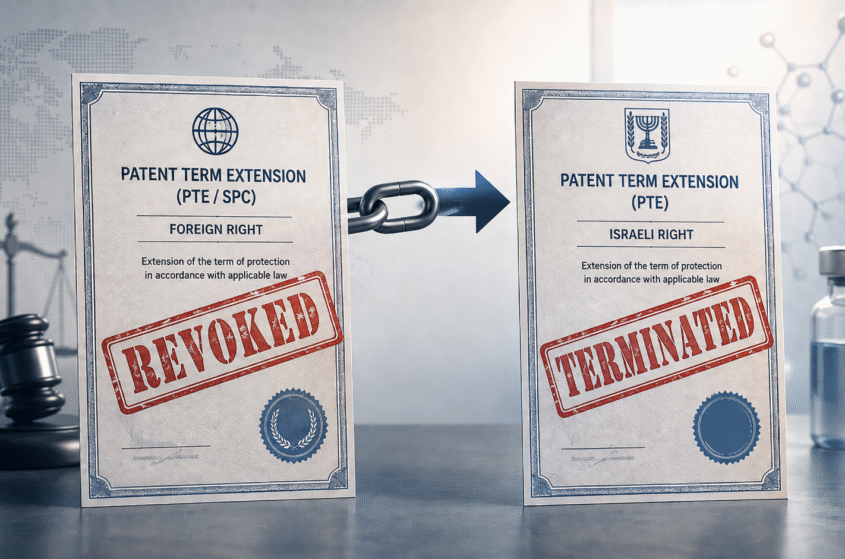
IL PTE Update: Revocation of Foreign PTE/SPC Can Terminate Israeli PTE Before It Enters into Force
In a recent judgment, the Tel Aviv District Court affirmed that an Israeli Patent Term Extension (PTE) expires upon revocation of a PTE/SPC for a reference patent in a Recognized Country, even if the Israeli PTE order has not yet entered into force.
Under the Israeli PTE regime, eligibility for a PTE is subject to the “Two-State Requirement” – grant of a PTE in the US and an SPC in at least one of the Recognized European Countries (Italy, the UK, Germany, Spain and France). The statutory PTE provisions also incorporate a linkage principle under which an Israeli PTE expires upon expiry or revocation of a relevant foreign reference patent or PTE/SPC in a Recognized Country.
The case concerned Genentech’s patent covering Tecentriq (atezolizumab). An Israeli PTE of 161 days had been granted but before it entered into force, the relevant European patent and SPCs were revoked. The ILPTO consequently revoked the Israeli PTE under the linkage principle.
Genentech argued that an Israeli PTE, which had not yet entered into force, could not “expire”, and that its PTE application should remain viable as the “Two-State Requirement” could still be satisfied before the original expiry of its patent through the grant of new SPCs in the Recognized European Countries.
The Court rejected both arguments. It held that once a PTE order is granted, the earlier procedural stages are superseded and the PTE application cannot be revived. It further held that a granted PTE order is a valid legal instrument capable of expiring even before its operative period begins. Accordingly, revocation of the relevant foreign right has immediate effect on the Israeli PTE.
The judgment reinforces the strict linkage between Israeli PTEs and corresponding foreign rights, as well as the formal approach taken by the Israeli Patent Office and courts in applying Israel’s PTE legislation.
Genentech Inc. v. Commissioner of Patents, VCA 40718-02-24, judgment dated August 23, 2026.
This update article is provided for general information only and is not in lieu of legal advice. Please contact us directly for any required advice on specific matters.