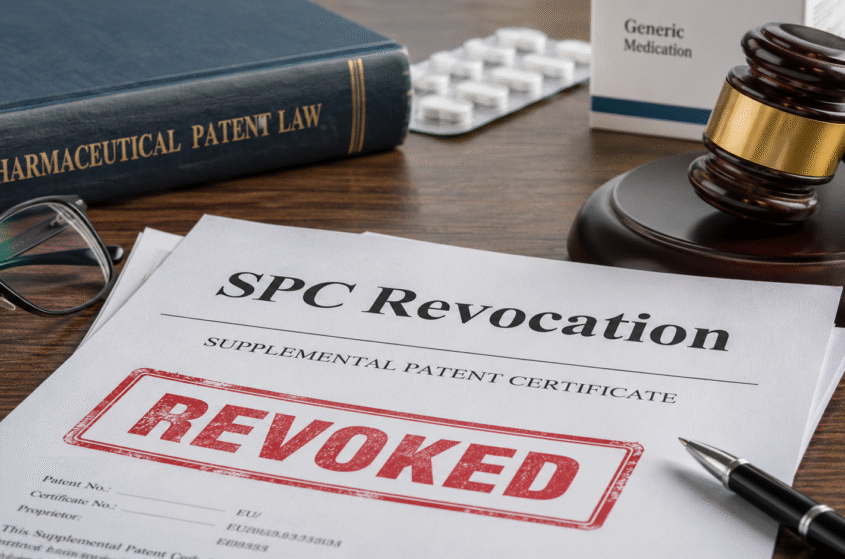
IL PTE Update: Revocation of a single SPC in the Recognized European Countries invalidates the corresponding IL PTE
In a recent judgment, the Jerusalem District Court affirmed the decision of the Deputy Commissioner of Patents that the revocation of an SPC for a reference patent in any Recognized European Country automatically invalidates the corresponding PTE order in Israel, even if SPCs for reference patents in other Recognized European Countries remain in force.
Under the Israeli PTE provisions, eligibility for PTE is subject to the ‘Two-State Requirement’, i.e., grant of a PTE in the US and grant of an SPC in at least one of the Recognized European Countries (UK, DE, FR, ES, IT). The IL PTE provisions also provide for a ‘linkage principle’ whereby an IL PTE order expires upon the expiry or revocation of any PTE/SPC for a reference patent in the US or in the Recognized European Countries.
Following the revocation of the UK patent for apixaban and its corresponding SPC, the Manufacturers’ Association, representing the local generic industry, and additional generic companies, petitioned to revoke the PTE order granted for the corresponding IL compound patent, arguing that it had automatically expired in accordance with the ‘linkage principle’.
Patentee argued that the revocation of the UK SPC had no impact on the IL PTE, which continued to remain in force, because except for the UK SPC, the SPCs for apixaban in all other Recognized European Countries remained in force. Patentee’s position was that the ‘linkage principle’ must be aligned with the ‘Two-State’ eligibility requirement which is satisfied as long as at least one SPC remains in force in the Recognized European Countries. Patentee also argued that in view of the retrospective effect of the revocation of the UK SPC, the present situation should be assessed as if a UK SPC had never been granted which would not have prevented the grant of the IL PTE in accordance with the ‘Two-State Requirement’.
The Deputy Commissioner acknowledged the anomalous asymmetry between the ‘Two-State’ eligibility requirement and the ‘linkage principle’ but held that she is constrained by the statutory language (“revocation of any SPC” is an invalidating event) and by the case law requiring strict literal interpretation of the PTE provisions. Patentee appealed the Deputy Commissioner’s decision to the Jerusalem District Court which affirmed the Deputy Commissioner’s holding. Like the Deputy Commissioner, the Court also based its holding that the revocation of a single SPC in the Recognized European Countries automatically invalidates the IL PTE on the plain meaning of the statutory text. The Court further held in this regard that the plain statutory language of the PTE provisions should be strictly followed, even in cases where such language leads to anomalous consequences in view of the legislature’s attempt to reach a compromise between competing interests.
This District Court judgment accordingly joins a long line of decisions in which Israeli courts pursued a simplistic formal approach to the interpretation of the complex IL PTE provisions departing from the purposive interpretation of statutory provisions that is typically applied by IL courts in other matters.
[Judgment dated May 11, 2026, in VCA 60673-01-25, Bristol-Myers Squibb Holdings Ireland Unlimited Company v. Unipharm Ltd. et al.]
This update article is provided for general information only and is not in lieu of legal advice. Please contact us directly for any required advice on specific matters.